In Australia, the issue of 3D-printed guns has moved from being a fringe concern to a serious challenge for law enforcement. As 3D-printing technology becomes more accessible, the chance that someone might try to build an unlicensed firearm at home goes up.
Here’s a look at what the law says, how recent enforcement actions have played out, and why you should pay attention if you live in Australia or follow its legal landscape.
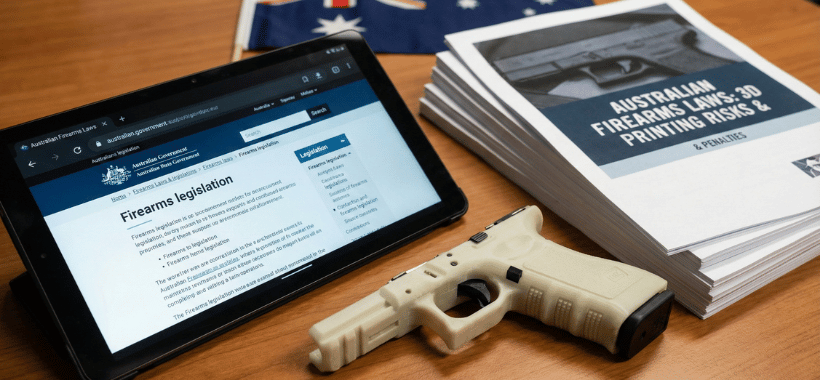
What the Law Says?
For the most part, Australia treats 3D-printed firearms just like traditional firearms. The national firearms laws don’t yet single out 3D-printing technology itself — owning a 3D printer or filament is not illegal.
But once a firearm — or a firearm part — is manufactured or assembled without a licence, it becomes an illegal weapon. That applies whether the gun was made in a traditional gunsmith workshop or using a 3D printer.
In certain states the law is even stricter. For example:
In Firearms Act 1996 (NSW), possessing digital blueprints or files that enable the manufacture of a firearm is itself a criminal offence. The maximum penalty under that provision can be as high as 14 years in jail.
In Tasmania, possessing such blueprints may attract even heavier penalties (up to 21 years, under local law).
That said, the laws vary from state to state, and only a few jurisdictions have explicitly outlawed digital designs, meaning there are gaps from one region to another.
So while owning a 3D printer or filament remains legal, producing or possessing a working firearm — or even the plans to build one — is widely treated as a serious crime.
Why Authorities Are Concerned
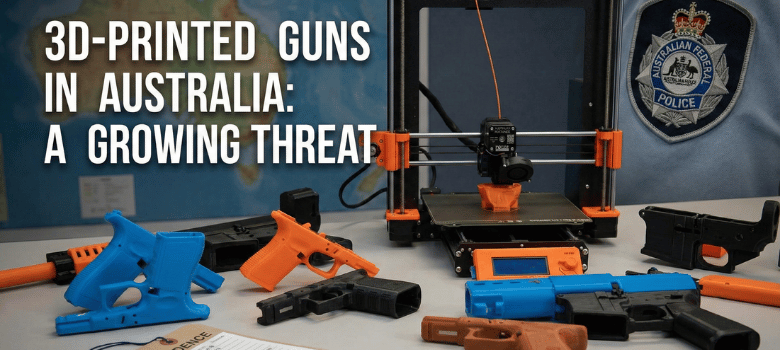
Over the past few years, police and border-control agencies have seen a sharp rise in 3D-printed or privately manufactured firearms being seized across Australia.
Among the models that have drawn attention is the FGC-9 — a semi-automatic weapon that, if manufactured properly, can fire dozens of rounds without needing to reload.
What makes these guns especially dangerous is that they often have no serial numbers and may use a mix of printed parts and conventional components, making them harder to trace than factory-made firearms.
Experts warn that hybrid firearms — those built partly by 3D printing, partly with traditional parts — are becoming more common, raising the stakes for public safety.
The Risks to Society
Because 3D-printed guns can be made in private homes, outside conventional oversight, they pose several worrying problems:
Untraceability: Without serial numbers or registration, tracking who made or used the gun becomes very difficult.
Ease of access: A basic 3D printer and widely available materials can be enough. That lowers the barrier to entry for criminals or individuals who wouldn’t pass legal firearms licensing.
Reliability concerns: While earlier versions of 3D guns were unreliable or low-powered, recent models like the FGC-9 have shown they can perform as effectively as conventional guns.
Threat to police and public: Law enforcement agencies have warned that such weapons — lacking standard safety and identification features — are a major risk to officers and community safety.
Why This Matters Beyond Just Australia?
Even though the laws are strict, 3D-printed firearm manufacturing shows how advances in technology can outpace regulation. Many feel that existing laws were written before home 3D printing was common — making enforcement a challenge.
Because regulations differ among states, someone might try to exploit loopholes by producing firearms in one jurisdiction and transporting them to another.
Also, what happens in Australia may be a warning sign for other countries: as 3D-printing becomes more accessible globally, the risk of illicit firearms rising elsewhere increases too.
What You Should Know?
If you live in or travel to Australia — or if you follow issues around firearms laws — here are some key takeaways:
- Using a 3D printer or owning one is not illegal by itself.
- Manufacturing or possessing a 3D-printed firearm without a proper licence is illegal, and penalties can be severe depending on the state.
- Having digital blueprints or files for a gun may itself be an offence in some jurisdictions.
- Hybrid firearms (combining printed parts with traditional components) are increasing, and authorities treat them as seriously as regular guns.
- Law enforcement and customs authorities are on high alert, and recent crackdowns have already led to hundreds of arrests.
Final Thought
The technology behind 3D printing is powerful and in many cases, beneficial. But when that power is used to make illicit firearms, risks to public safety grow rapidly. Australia has some of the world’s strictest gun laws, and authorities continue to adapt as 3D-printing becomes more accessible. For anyone interested in technology, crime prevention, or public safety — this is not a fringe issue. It’s a serious challenge that affects communities, law enforcement, and legislation across the country.